
Improve Plant Diversity With the Right Herbicide at the Right Time in the Right Amount
By Ellen H. Brisendine
“I didn’t know herbicides worked that way,” and “I didn’t know I could do that with herbicides,” are two of the most common comments that range management specialists hear from landowners who want to manage the brush encroaching on their land, says Dr. Charles Hart, Corteva Agriscience.
New landowners who want to manage for wildlife habitat may not have experience with herbicides, other than those they might have used on a residential lawn. “Often,” Hart says, “their common assumption after they buy a ranch and decide they want to use it for wildlife is that they can’t spray brush, ‘because herbicide kills everything.’ New landowners might not know about the selectivity we have when it comes to using herbicides in a brush control program. Selectivity is based on the product you choose to use, on the application method and on the timing,” he says.
Know what product to use and how much to use
“There are products that are very nonselective and there are products that are very selective,” Hart says. Take the time to learn how various herbicides work and the plants on which they are active.
For example, Spike® 20P, a pelleted product: “Spike is going to be fairly nonselective at higher application rates, but when we lower the application rate it becomes more selective and kills only certain species. That is exactly why, with some of the species that are harder to control, our application rate is higher, because at lower application rates, it doesn’t kill that species.”
In a range and pasture environment, Spike 20P is used to treat brush such as creosote, tarbush, catclaw, juniper, lotebush and “some of those brush plants that we just don’t get very well with liquid, foliar active herbicides,” he explains.
Sendero®, a liquid product, is another herbicide that is “fairly selective when it comes to brush and it works mainly on the legume family — mesquites, honey locusts, plants that are in the legume family,” he says. This selective herbicide can be applied aerially to take out specific brush, such as mesquite, without harming plants that are desirable to wildlife populations.
Hart says that mixing a product such as Sendero with other herbicides, such as Tordon™ 22K or Remedy Ultra, causes the herbicide to be “less selective and we take out more species.”
When Tordon 22K, a picloram-based product, is applied aerially, Hart explains, “It will take the leaves off of almost everything that is green and growing. This doesn’t mean it’s going to kill everything, but you are going to know you sprayed. With Sendero, you can fly over desirable trees and not disturb those trees, or maybe you will affect the leaves for a short time. In general, we can be selective based on the herbicide itself.”
If learning how the herbicide molecule affects plants sounds challenging, Hart says he agrees. “We don’t just automatically know this.” As a researcher, he and his colleagues spent about six years doing research trials to determine what Sendero does and does not affect. “With new chemistry, with new molecules, we have to go through that process, and it takes time.”
Choose the proper application technique
The general application techniques, ranked from most to least selective, are individual plant treatment (IPT), then ground broadcast application, and then aerial application.
“If we’re really concerned about a particular species or we want to kill smaller plants and leave the larger ones, then we can use the IPT method. This will allow us to use herbicides on the plants we want to manage and avoid spraying those plants we want to keep but are susceptible to that herbicide. IPT will help us sometimes avoid the damage that we could do with broadcast application.”
Aerial application allows the landowner to treat large acreages but, “we become a little more limited. With the GPS technology that we have today, we can avoid major areas that have the species we want to keep — just not spray them. Is that going to be an individual plant scattered throughout the pasture? No. But if there is an oak motte or a species that we want to keep, we can avoid it with either the application or with using a herbicide that is not active on that desirable species,” he says.
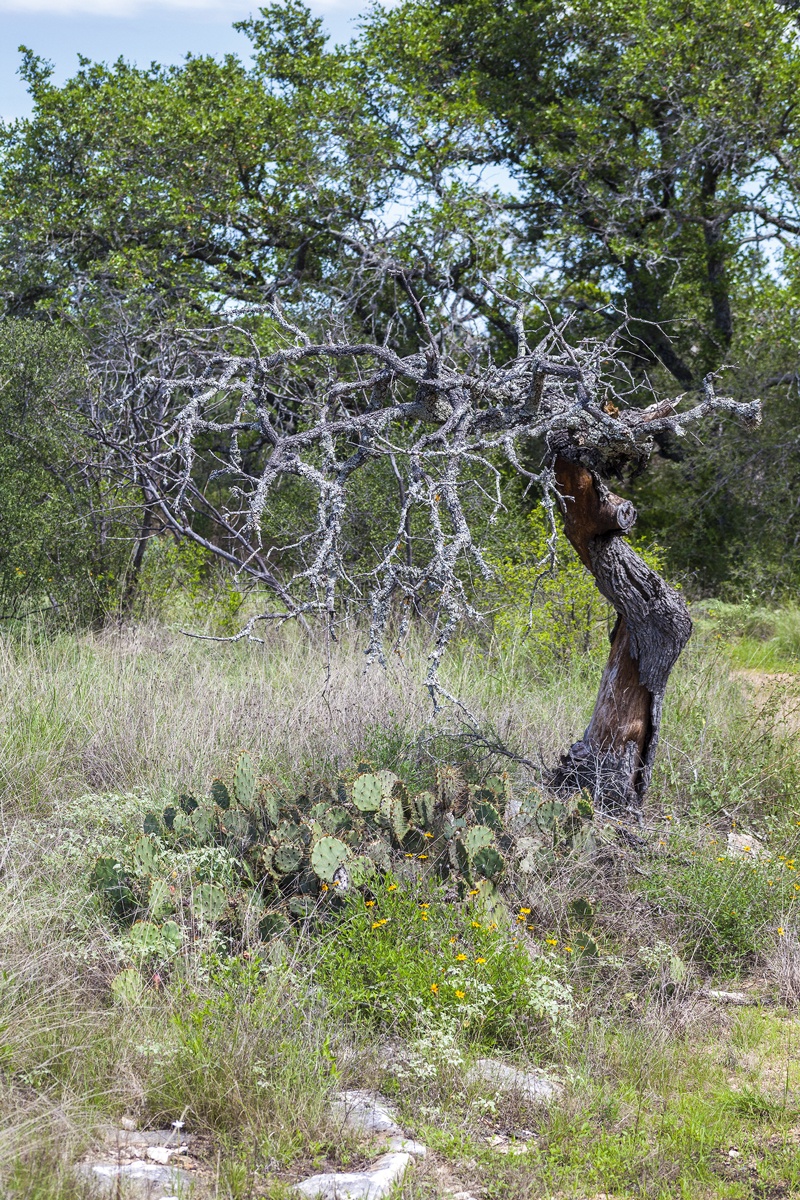
Timing of an application can affect the outcome, Hart says, using spring treatment of pricklypear as an example. “We want to control pricklypear, but maybe we want to do less damage to our oak species. We accomplish this by applying herbicide on the pricklypear early in the season before the oaks put on new leaves for the year.
“Then, when we spray, the herbicide lands on the older oak leaves which have a heavy wax coating,” he says. The older leaves with the heavier wax coat are less damaged by herbicide, and “then, if we have timed the application correctly, within a matter of weeks to a month those oaks will drop the old leaves and put on new leaves,” he explains.
“If the landowner doesn’t want to hurt the mesquite on his or her land, then we can spray species such as pricklypear before there are leaves on the mesquite. The herbicide actually goes through the mesquite branches to get the pricklypear with little damage to the mesquite trees,” he says.
Properly chosen herbicides, applied at the proper rate, at the proper time and with the right method will allow the landowner to increase the diversity of plant species on the land. Hart says, “If you have a pasture that is dominated by mesquite, but you have a few other wildlife-friendly species scattered in among the mesquite, if we control the mesquite over time those other species are going to flourish. It is a misperception that herbicides kill everything in a pasture. Actually, over time, the opposite happens. When we reduce the dominant species, the other species start to thrive. We get more of the species out there that are each less dominant.”
Any weed or brush species that are noxious or invasive by nature tends to decrease biodiversity. By managing those species, you can increase biodiversity on the ranch. “Quite frankly, that’s what makes for good wildlife habit — increasing biodiversity,” Hart says.
Identify Warm-Season Perennial Grasses, Beneficial Brush Species
Brush species will be growing in June, and some will be flowering or starting to put out fruit or seed pods. “Even though it’s hot, it’s a really good time to go out and begin to identify what your desirable brush species are because they’re going to be actively growing,” says Dr. Charles Hart, Corteva Agriscience.
“If they’re flowering or fruiting this is one of the best and easiest times to identify that plant. This is also the time when our warm-season perennial grasses really should be pretty much headed out (flowering) or getting close anyway. This is a good time of year to identify your desirable warm-season perennial grasses.”
Take advantage of cool mornings to walk through your pastures to see what is out there. Keep your camera or smartphone with you to take a picture of the plants on your land. Add them to a print or digital photo collection to begin your own plant inventory and plant identification resource for your ranch.
Improve Plant Diversity is excerpted from the June 2019 issue of The Cattleman magazine.